With objective analysis, reliable KPIs, and clear recommendations, XTRA-E® helps companies use energy more efficiently, reduce costs, and make a measurable contribution to climate protection.
XTRA‑E® accompanies companies from strategy through procurement to the implementation of decarbonization, ESG, and renewable energy systems.
XTRA‑E® is the independent strategy consultancy for energy and transformation. We help companies strategically realign their energy supply – economically, resiliently, and sustainably.
Our consulting approach combines strategy development, implementation, and continuous optimization into an integrated transformation process. We support our clients from developing robust energy strategies through successful implementation and long-term management.
At the core are competitiveness, security of supply, and decarbonization. We provide decision-making foundations for complex investments, support in navigating regulatory requirements, and develop solutions that combine environmental responsibility with economic success.
For us, sustainability is not an isolated goal but a central driver of resilience, value creation, and long-term competitiveness.
We develop strategies and support their implementation across the entire energy value chain – from procurement, infrastructure, and supply to regulation, compliance, and decarbonization.
Robust energy and decarbonization strategies for sustainable and profitable business success.
Learn more →Optimized procurement processes, portfolio management, and hedging strategies for volatile markets.
Learn more →Conception, economic viability assessment, and implementation of renewable energy projects – from feasibility to operation.
Learn more →Technology assessment, business case development, and integration of storage solutions into your energy system.
Learn more →Planning, optimization, and financing of energy infrastructure – from grid connection to self-supply.
Learn more →Structuring and supporting energy contracting models, PPA negotiations, and operator models.
Learn more →Systematic recording, reduction, and compensation of emissions – Scope 1–3, GHG Protocol, CSRD.
Learn more →ESG strategy development, reporting, rating preparation, and integration into corporate management.
Learn more →Risk management, regulatory compliance, and building resilient energy supply structures.
Learn more →Strategic investment planning, due diligence, and transaction support in the energy sector.
Learn more →Every industry faces specific challenges – from rising energy costs and regulatory requirements to the decarbonization of critical value chains. We combine deep industry knowledge with sound energy expertise to develop solutions that strengthen economic performance, security of supply, and sustainability equally. Our focus is on industry, infrastructure, and the public sector.
Structured. Pragmatic. Impactful.
Analysis of the current situation, identification of savings potential, and assessment of regulatory requirements.
Detailed evaluation of energy flows, cost structures, and risk factors – data-driven and transparent.
Development and implementation of tailored transformation plans – from strategy to operational integration.
Continuous monitoring, adjustment, and improvement – for sustainable profitability and resilience.
The XTRA-E® Intelligence Platform connects energy, ESG, CO₂, and economic data to create an integrated decision-making foundation. It supports executives in managing complex transformation processes and developing economically sustainable strategies.
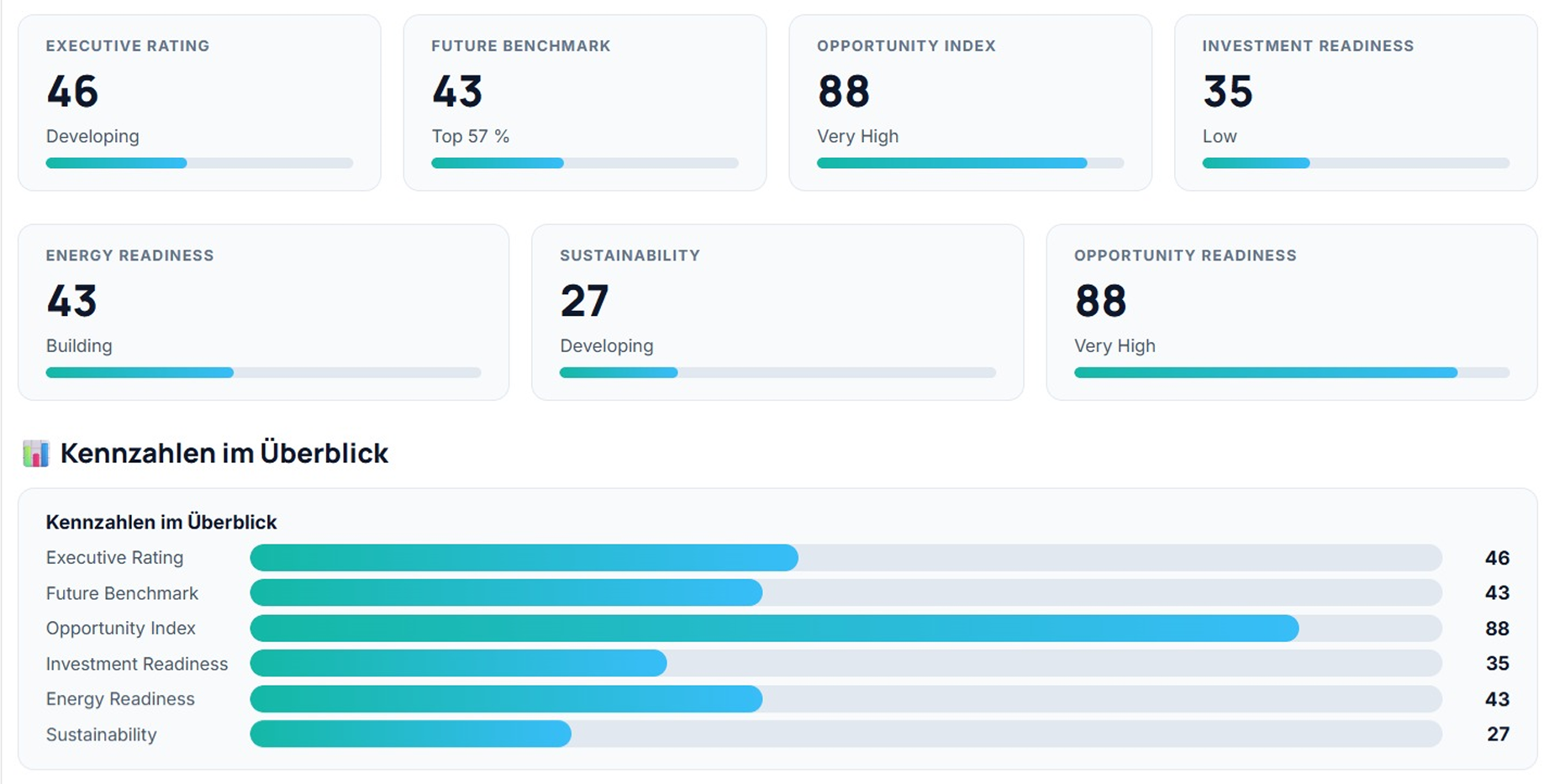
Transparency creates trust. Our platform condenses complex data into clear recommendations for action – for your decisions at the executive level.
Analyses, studies, and benchmarks on key developments in energy and transformation topics. We provide orientation in complex markets and deliver the relevant perspectives executives need for strategic decisions.
An informal initial meeting – no obligation, just perspectives.
Schedule a meetingThe transformation of the energy system is one of the central challenges of our time. Companies and public institutions face the task of successfully combining rising costs, regulatory requirements, and the shift towards a climate-neutral economy.
We help organizations translate energy and sustainability strategies into tangible value creation. We combine deep industry knowledge with sound energy expertise to develop solutions that strengthen economic performance, security of supply, and sustainability equally.
Our approach is based on a holistic view: we analyze complex challenges, identify strategic fields of action, and support implementation along the entire value chain. From optimizing existing structures to developing future-proof transformation paths, we create the foundation for long-term competitiveness.
Our focus is on industry, infrastructure, and the public sector. Where energy, technology, and strategic decisions come together, we create clarity, reduce complexity, and support our clients in implementing sustainable change.
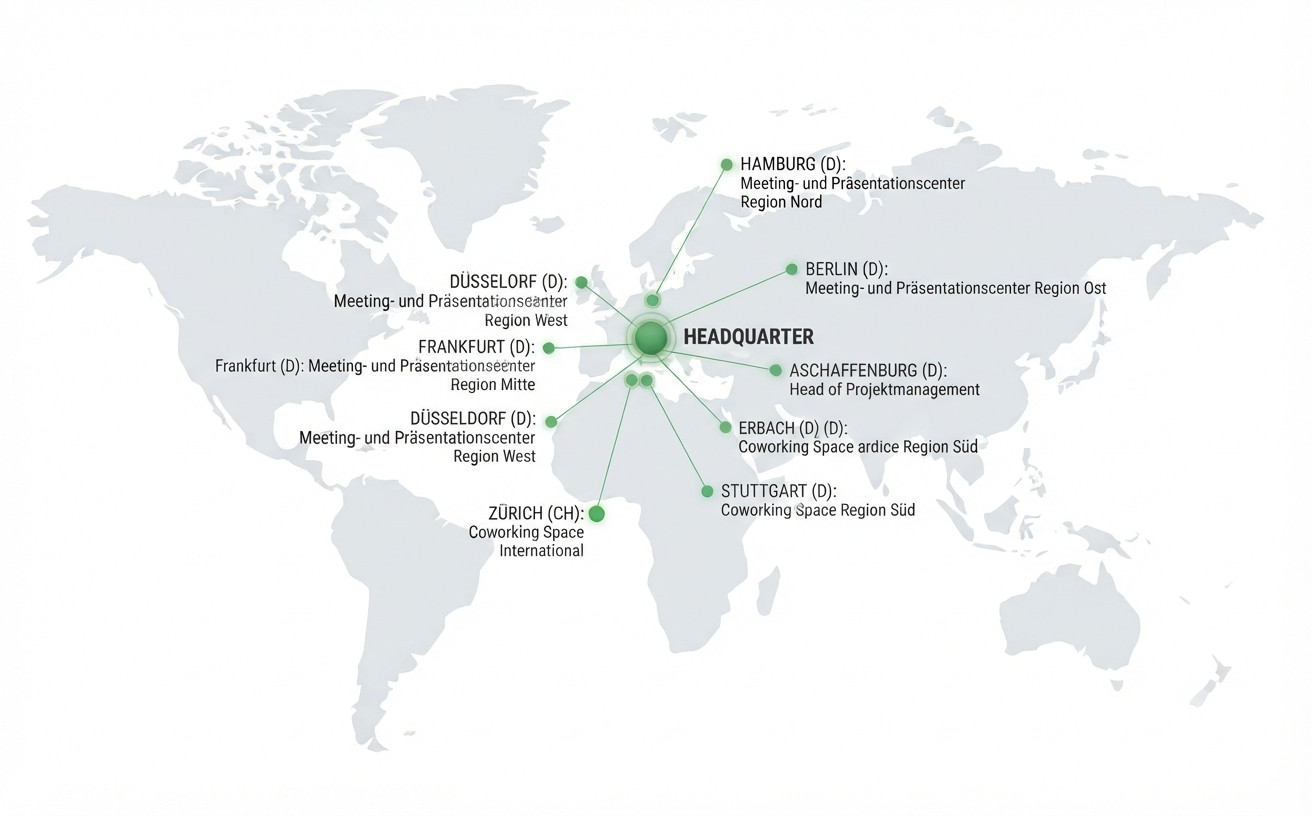
Cross-regional presence in Germany and Switzerland.
The brand XTRA-E® is part of the Green Shark Group and operates at strategically selected locations in Germany and Switzerland.
Strategic energy consulting. Optimized costs. Sustainable value creation.
CEO Green Shark Group
Thomas Heilmann stands for strategic foresight, entrepreneurial transformation, and the consistent integration of technology, economic efficiency, and sustainable development.
Since 1997, he has been advising companies as a strategy consultant on navigating complex change processes and building future-proof business models. His career began in technology consulting with a focus on telecommunications and IT. There, he developed a deep understanding of digital transformation, technological scaling, and the importance of reliable decision-making bases.
With the shift in the energy sector, Thomas Heilmann recognized the strategic importance of renewable energy early on and consistently focused his entrepreneurial efforts on developing sustainable energy systems. Since 2018, he has concentrated his expertise entirely on the transformation of the energy market and shaping the energy transition.
As a strategist with a strong future perspective, he combines market understanding, technological developments, and economic analyses to form clear strategic decisions. His particular strength lies in translating complex issues into robust business models and precise calculation bases – from initial idea to successful implementation.
As a developer of innovative products in the renewable energy sector and project developer for energy facilities, Thomas Heilmann is responsible for the strategic direction of the Green Shark Group. His aspiration is to create solutions that combine ecological transformation with economic viability and enable long-term value creation.
His perspective:
A successful energy transition requires more than technological innovation. It needs strategic clarity, economic precision, and the ability to recognize future developments early and translate them into concrete projects.
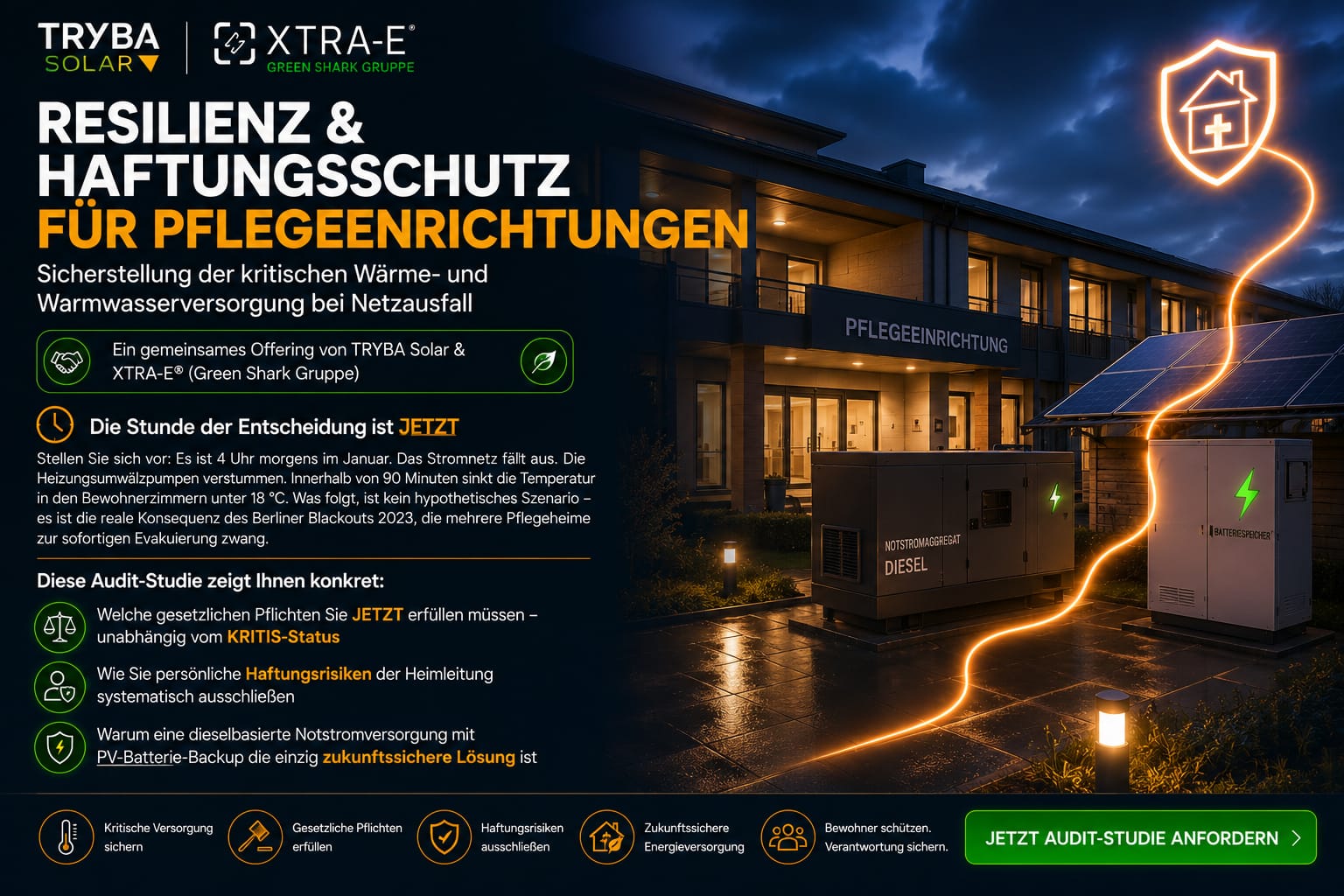
Ensuring critical heating and hot water supply during grid failure
A joint offering from TRYBA Solar & XTRA-E® (Green Shark Group)
Imagine: It's 4 a.m. in January. The power grid fails. The heating circulation pumps stop. Within 90 minutes, the temperature in resident rooms drops below 18 °C.
This audit study shows you specifically:
According to DIN SPEC 1946-7:2022-05, Section 5.3.1:
"In facilities with persons requiring care, a minimum temperature of 20 °C must be maintained in living spaces for at least 24 hours even in the event of a main power supply failure."
According to BGB § 823 Paragraph 1:
"Whoever intentionally or negligently unlawfully injures the life, body, health [...] of another is obliged to compensate the other for the resulting damage."
According to the Occupational Safety Act § 3 Paragraph 1:
"The employer is obliged to take the necessary occupational safety measures, taking into account the risks to employees and third parties."
According to BSI-KritisV § 2 Paragraph 1 No. 7:
"KRITIS facilities in the health sector are hospitals with more than 30,000 full inpatient cases per calendar year."
Nevertheless, stricter obligations apply:
Since the entry into force of the Act to Strengthen Security in Information Technology (IT-SiG 2.0) in May 2024:
According to § 8b BSIG n.F.:
"Operators of special facilities must take appropriate measures to maintain functionality during disruptions to the energy supply and document these in a resilience plan."
Nursing homes are considered 'special facilities' according to § 2 No. 15 BSIG
Consumers: Heating circulation pumps, hot water supply, emergency lighting
Normative requirement: DIN VDE 0100-710: maximum transfer time 15 seconds
Supply technology: Diesel generator with automatic start
Consumers: General lighting, food refrigeration, sanitary areas
Normative requirement: DIN VDE 0100-560: minimum autonomy time 120 minutes
Supply technology: Battery storage with optional PV charging
The technology is available. The standards are clear. The legal obligation is undisputed.
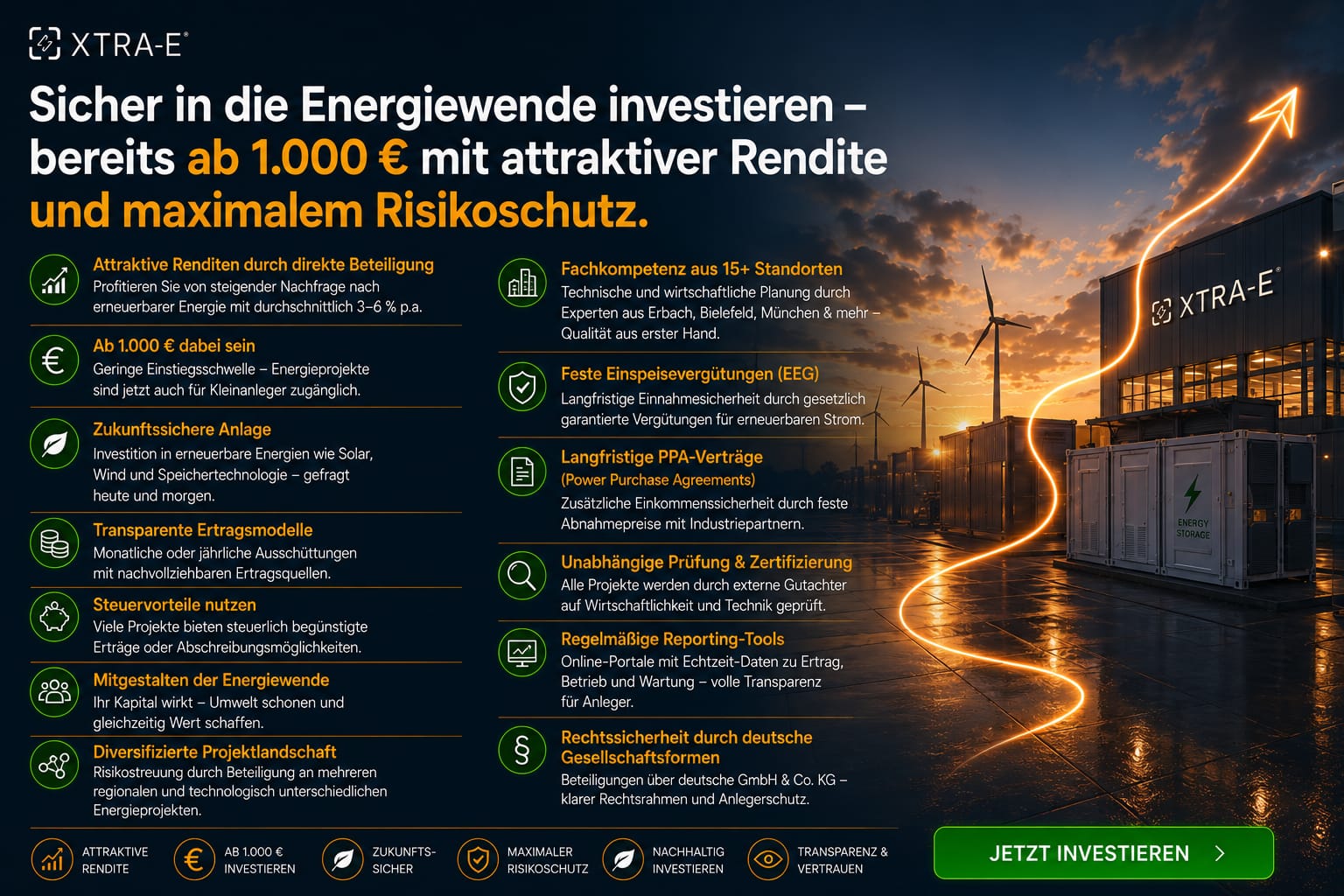
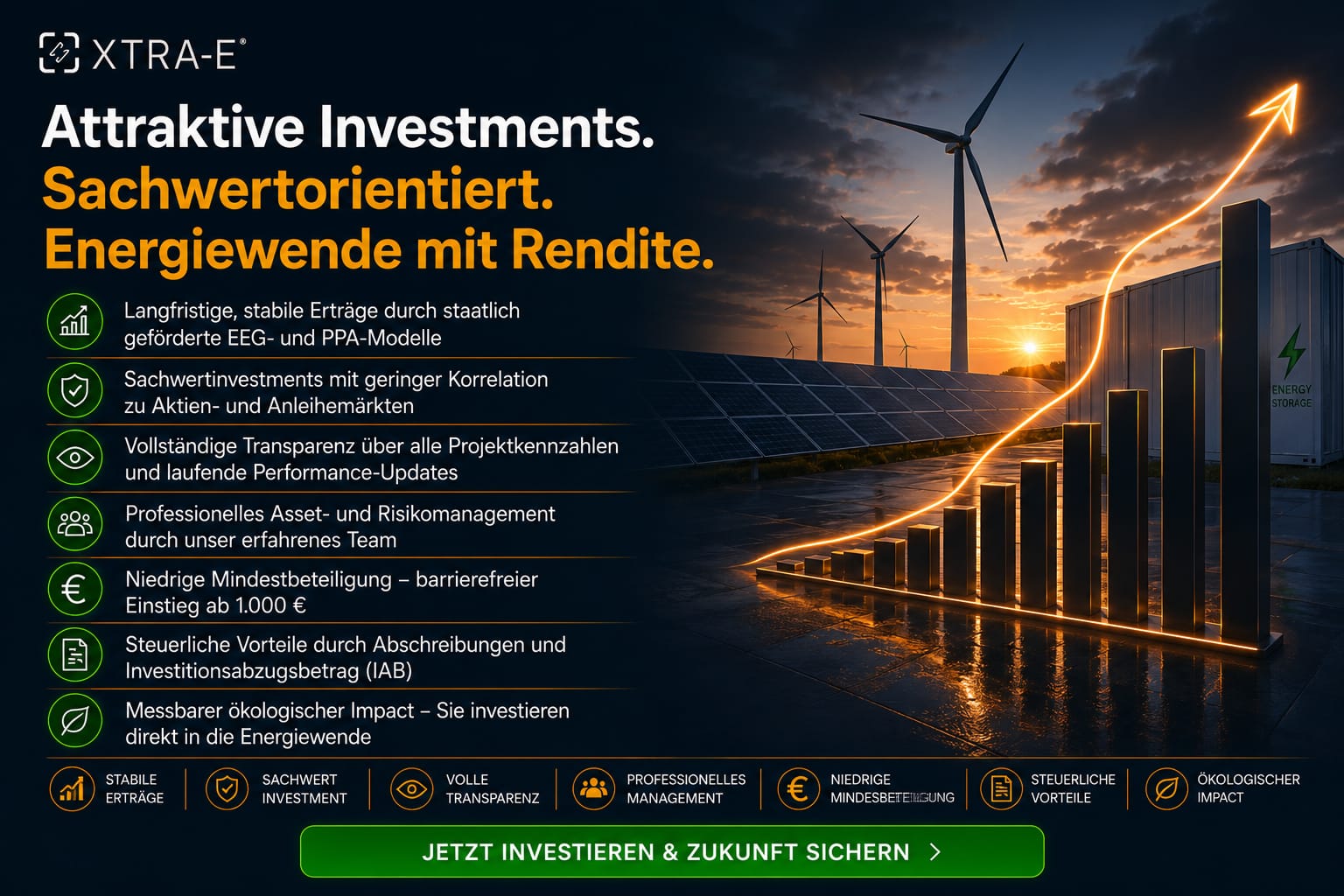
Invest securely in the energy transition – from as little as €1,000 with attractive returns.
Manufacturing companies are facing fundamental change: volatile energy markets, rising regulatory requirements, and pressure to decarbonize are transforming the conditions for industrial value creation. We help companies strategically align their energy use and develop sustainable competitive advantages from it.
Industrial production faces the challenge of optimizing cost structures while enabling investments in a climate-ready future. Energy-intensive processes, complex supply chains, and increasing demands for transparency and sustainability require integrated strategies that combine economic efficiency and transformation.
We combine a deep understanding of industrial value creation with comprehensive energy expertise. Together with our clients, we develop solutions along the entire energy value chain – from strategic direction through technology decisions to implementation and long-term optimization.
We create the foundation for a competitive industrial future – through the combination of operational excellence, sustainable transformation, and strategic energy expertise.
The automotive industry is in the midst of profound transformation. Electrification, new production processes, volatile energy markets, and increasing sustainability requirements are fundamentally changing industrial value creation. We support automotive companies in strategically aligning their energy and transformation strategies and securing long-term competitiveness.
Automotive manufacturers and suppliers face the challenge of combining rising energy and production costs with the requirements of climate-neutral mobility. The transformation of vehicle technologies, production sites, and supply chains requires new strategies for energy supply, decarbonization, and investment decisions.
We combine a deep understanding of automotive value creation with strategic energy expertise. Together with our clients, we develop integrated solutions along the entire energy and production chain – from strategic energy alignment through decarbonization paths to the implementation of resilient supply concepts.
We support automotive companies in leveraging the energy transition as a strategic competitive advantage – through the combination of cost efficiency, decarbonization, and resilient industrial value creation.
The pharmaceutical and chemical industry is one of the most demanding energy-intensive sectors. High requirements for security of supply, regulatory compliance, and sustainable production meet volatile energy markets and increasing transformation pressure. We support companies in strategically aligning their energy supply and securing sustainable competitiveness.
Pharmaceutical and chemical companies face the challenge of reliably operating complex production processes while optimizing costs, emissions, and regulatory requirements. Critical infrastructures, high quality standards, and continuous production demands require integrated strategies for energy efficiency, resilience, and decarbonization.
We combine a deep understanding of industrial processes with strategic energy expertise. Together with our clients, we develop tailored solutions along the entire energy value chain – from strategic energy alignment through decarbonization paths to implementation and continuous optimization.
We create the foundation for a sustainable pharmaceutical and chemical production – through the combination of security of supply, economic efficiency, and sustainable transformation.
The food and beverage industry faces increasing demands for efficiency, sustainability, and security of supply. Energy-intensive processes, volatile cost structures, and growing expectations from customers, retailers, and regulators require new approaches for sustainable industrial value creation. We support companies in strategically aligning their energy and transformation strategies.
Producers face the challenge of combining competitive cost structures with ambitious sustainability goals. Refrigeration, heating processes, production, and logistics define energy demand and require integrated strategies for increasing efficiency, decarbonization, and operational resilience.
We combine industry knowledge of food and beverage production with strategic energy expertise. Together with our clients, we develop solutions along the entire energy value chain – from strategic direction through optimization potential to the implementation of future-proof supply concepts.
We support food and beverage companies in using energy as a strategic lever – for more efficient processes, more resilient value creation, and a sustainable competitive position.
The logistics and transport industry is undergoing profound change. Electrification of vehicle fleets, rising energy costs, new regulatory requirements, and changing mobility concepts present companies with strategic challenges. We support logistics and transport companies in aligning their energy and transformation strategies and creating sustainable competitive advantages.
The transition to low-emission and electrified transport solutions is changing business models, infrastructure, and operations. Companies must combine increasing requirements for CO₂ reduction, energy supply, and economic efficiency. In particular, building powerful charging infrastructure, integrating renewable energy, and optimizing future energy needs require a holistic strategy.
We combine a deep understanding of logistics value creation with strategic energy and transformation expertise. Together with our clients, we develop integrated solutions for fleets, sites, and energy supply – from strategic roadmap through investment decisions to successful implementation.
We support logistics and transport companies in leveraging the energy transition as a competitive advantage – through the combination of electrification, efficient energy supply, and resilient value creation.
The property management sector is facing profound change. Rising energy costs, stricter regulatory requirements, and the growing demand for sustainable buildings are changing the requirements for managing and developing property portfolios. We support property managers in developing energy and sustainability strategies that optimize operating costs, reduce risks, and secure long-term value creation.
Property managers face the task of aligning existing portfolios to be economically efficient and future-proof. Energy consumption, CO₂ emissions, and regulatory requirements are becoming key control parameters for property values. The challenge is to integrate technical measures, investments, and sustainability goals into an integrated portfolio strategy.
We combine property understanding with strategic energy and transformation expertise. Together with our clients, we develop holistic concepts for existing properties and portfolios – from energy profile analysis through decarbonization path development to the implementation of economically viable measures.
We support property managers in using energy and sustainability as strategic value drivers – for more efficient buildings, resilient portfolios, and long-term value creation.
The retail sector is facing fundamental change. Rising energy costs, increasing competitive pressure, and new regulatory requirements are changing the demands on large retail spaces. We support retail companies in optimizing their energy and sustainability strategies and developing long-term competitive advantages from energy efficiency, decarbonization, and resilient supply concepts.
Large retail spaces are among the most energy-intensive operating models in the building sector. Refrigeration, lighting, air conditioning, and technical infrastructure significantly determine operating costs and CO₂ balance. At the same time, companies must operate their sites economically, meet regulatory requirements, and prioritize investments in a sustainable future.
We combine a deep understanding of retail processes and site structures with strategic energy expertise. Together with our clients, we develop integrated concepts for individual sites and entire property portfolios – from energy analysis through transformation path development to implementation and optimization.
We support retail companies in using energy as a strategic value driver – through lower operating costs, more resilient sites, and sustainable transformation of their branch and property portfolio.
The healthcare sector is facing profound transformation. Rising operating costs, growing regulatory requirements, and the demand for sustainable care increase strategic pressure on hospitals, clinics, and healthcare facilities. We support organizations in making their energy supply future-proof and connecting economic, ecological, and operational goals.
Healthcare facilities are among the most energy-intensive and critical infrastructures. Continuous operation, high safety and quality requirements, and complex technical systems demand reliable energy supply. At the same time, operators must increase energy efficiency, reduce emissions, and strategically prioritize long-term investments.
We combine a deep understanding of healthcare requirements with strategic energy and transformation expertise. Together with our clients, we develop integrated energy and sustainability strategies – from analyzing existing supply structures through developing decarbonization paths to implementing economically viable measures.
Resilience & liability protection for care facilities
Care facilities are particularly liability-relevant due to their special responsibility towards vulnerable individuals and their dependence on uninterrupted energy supply. Legal regulations, building requirements, and industry-specific standards demand the establishment of resilient energy supply concepts. We support operators in systematically meeting these requirements, minimizing failure risks, and reducing legal liability risks.

More information →
We support healthcare facilities in using energy as a strategic success factor – for secure supply, economic stability, and sustainable future-proofing.
Utility companies are at the center of the energy transition. The shift to renewable energy, decentralized supply concepts, rising regulatory requirements, and new market mechanisms are fundamentally changing the role of traditional energy suppliers. We support utility companies in making their strategies, business models, and infrastructure future-proof.
The transformation of the energy system requires far-reaching decisions along the entire value chain. Energy suppliers must ensure security of supply, further develop grids and generation structures, and simultaneously meet economic and regulatory requirements. The integration of renewable energy, flexibility solutions, and new technologies creates new opportunities but increases the complexity of strategic decisions.
We combine a deep understanding of energy markets, regulatory frameworks, and technical infrastructure with strategic transformation competence. Together with our clients, we develop integrated strategies – from strategic positioning through investment decisions to the implementation of future-proof business models.
We support utility companies in strategically shaping the energy transition – through resilient infrastructure, innovative business models, and sustainable value creation in the energy system of the future.
We develop future-proof energy strategies that reduce costs, increase resilience, and enable sustainable growth
The energy landscape is fundamentally changing: rising prices, regulatory pressure, volatile markets, and the transition to a climate-neutral economy present companies with new strategic challenges.
We support organizations in developing an integrated energy strategy – from analyzing the current energy profile through defining strategic target images to implementing concrete measures. We combine market understanding, technological expertise, and economic evaluation to create sustainable value contributions.
Today, energy is much more than a cost factor. It is becoming a strategic lever for competitiveness, security of supply, and decarbonization.
Companies need to answer key questions:
Our energy strategies create transparency and provide leadership teams with the foundation for informed decisions.
We develop a clear vision for your energy supply and define strategic priorities.
Our support includes:
Outcome: A clear strategic orientation with prioritized fields of action and investment decisions.
We connect climate goals with economic feasibility.
We support:
Outcome: An economically viable transformation plan to achieve your climate goals.
We design energy supply systems that optimize costs and reduce risks.
Our services:
Outcome: A resilient energy supply with optimized cost structures.
We evaluate technologies not in isolation but along their strategic and economic contribution.
We analyze:
Outcome: A prioritized investment agenda with clear economic viability and implementation perspective.
From analysis to implementation
We analyze energy consumption, cost structures, emissions, and external influencing factors.
We develop scenarios and evaluate strategic options regarding economic viability, risk, and sustainability.
We translate insights into a clear target image with concrete priorities.
We support governance, roadmap, initiative management, and realization of defined measures.
Strategic perspective meets operational implementation
Many energy initiatives fail not due to a lack of technology but a lack of strategic clarity.
We translate global energy developments into concrete business decisions.
We evaluate solutions along their technical and economic feasibility.
We accompany from strategy development to realization.
Each measure is prioritized based on its value contribution.
We help you turn transformation into opportunities – with an energy strategy that combines economic performance, sustainability, and resilience.
Let's shape your energy future.
We develop energy procurement strategies that optimize costs, reduce risks, and create long-term security of supply
Volatile energy markets, geopolitical uncertainties, and increasing sustainability requirements are fundamentally changing the rules of energy procurement.
Companies face the challenge of procuring energy not just cheaply but strategically: with the right balance of cost optimization, price stability, sustainability, and security of supply.
We support companies in realigning their energy procurement – from analyzing existing procurement models through developing individual procurement strategies to implementing efficient processes and structures.
For many companies, energy prices are among the key cost and competitive factors. At the same time, complexity is increasing due to:
Modern energy procurement must therefore do more than short-term price optimization. It must actively manage risks, create flexibility, and support strategic corporate goals.
We create transparency about your current energy procurement and identify concrete optimization potential.
Our support includes:
Outcome: A transparent picture of the current procurement situation and concrete levers for optimization.
We develop procurement models that fit your corporate strategy and risk profile.
We support:
Outcome: A robust procurement strategy with an optimized balance between price, risk, and flexibility.
We combine economic requirements with climate goals.
Our services:
Outcome: A sustainable energy supply that meets regulatory requirements and creates long-term planning security.
We help companies systematically manage energy price risks.
We analyze:
We develop:
Outcome: More stability and better decision-making capability in a dynamic energy market.
We support the professional management of energy partnerships.
Our services:
Outcome: Competitive terms and a professional procurement organization.
From analysis to the optimal procurement strategy
We analyze consumption, costs, contracts, and market conditions.
We define the optimal procurement model according to your goals and risk profile.
We develop concrete measures, tender models, and decision-making processes.
We establish structures for continuous optimization and market adaptation.
Market understanding combined with strategic implementation competence
Successful energy procurement requires more than price comparison. It needs a deep understanding of markets, risks, and business models.
Development of procurement models that support long-term corporate goals.
Assessment of price developments and hedging options.
Integration of renewable energy and decarbonization into procurement strategies.
Guidance from strategy to successful implementation.
We support companies in evolving their energy procurement from operational purchasing to a strategic competitive advantage.
Together, we develop a procurement strategy that combines economic stability and sustainable transformation.
Let's redesign your energy procurement.
We develop renewable energy solutions that enable decarbonization, reduce energy costs, and unlock new value potential
The transformation of the energy system is accelerating. Companies, municipalities, and private households face the task of making their energy supply more sustainable, independent, and economical.
Renewable energy is a key component: it reduces CO₂ emissions, increases energy autonomy, and creates long-term stability against volatile energy markets.
We support our clients in developing and implementing individual renewable energy strategies – from identifying suitable potential through economic evaluation to realizing concrete projects.
The energy transition is fundamentally changing the requirements for modern energy supply. Companies must find answers to key questions today:
We combine strategic perspective with technical and economic expertise to make renewable energy a competitive advantage.
We develop a clear strategy for expanding renewable energy – tailored to your energy goals, site conditions, and economic requirements.
Our support includes:
Outcome: A well-founded strategy for the economically optimal use of renewable energy.
Photovoltaics is one of the most important technologies for sustainable and decentralized energy supply.
Our services:
Outcome: Transparent decision-making bases for profitable solar projects.
We help companies integrate renewable energy into their energy supply.
We support:
Outcome: A more sustainable and resilient energy supply with measurable economic benefits.
We accompany the development of renewable energy projects along the entire value chain.
Our services:
Outcome: Investment-secure projects with a clear economic perspective.
Renewable energy achieves its greatest benefit through intelligent integration. We consider the entire energy system:
Outcome: Holistic energy solutions that combine security of supply and sustainability.
From strategy to renewable energy supply
We analyze energy needs, sites, technical possibilities, and economic framework conditions.
We compare technologies, business models, and investment variants.
We define a clear expansion path with prioritized measures.
We accompany the implementation of renewable energy projects – from planning to operation.
Strategy, technology, and implementation from a single source
The successful expansion of renewable energy requires more than individual projects. An integrated approach is crucial, combining technology, economic viability, and long-term corporate goals.
We develop solutions that fit your long-term energy and sustainability strategy.
We evaluate technologies holistically in terms of efficiency, scalability, and economic viability.
We create transparency about investments, returns, and long-term value contributions.
We accompany projects from idea to successful realization.
From strategic planning to implementation, we accompany projects along the entire value chain.
We develop and realize renewable energy generation plants for industrial, commercial, and public applications.
From initial potential analysis to turnkey implementation, we develop photovoltaic projects with optimal technical and economic design.
We enable companies and private households to enter an independent and sustainable energy supply with individually planned photovoltaic solutions.
We help companies, investors, and private clients strategically use renewable energy – for more sustainability, economic benefits, and long-term energy independence.
Together, we develop the energy supply of tomorrow.
Let's shape your renewable energy future.
We develop energy storage strategies that increase flexibility, optimize energy costs, and create the foundation for a resilient energy system
Increasing electrification, the expansion of renewable energy, and volatile energy markets are changing the requirements for modern energy infrastructures. Energy storage is evolving from a supplementary technology to a strategic component of energy supply.
Whether for self-consumption optimization, load flexibilization, grid stabilization, or marketing flexibility – battery storage and other storage technologies open up new economic potential and increase security of supply.
We support companies, project developers, energy suppliers, and investors in strategically evaluating storage solutions, economically designing them, and successfully integrating them into existing energy systems.
With the increasing share of fluctuating renewable energy, the need for flexibility in the energy system grows. At the same time, regulatory developments and new market mechanisms open up additional revenue potential.
Key questions include:
We develop strategies that reconcile technical feasibility, regulatory requirements, and economic objectives.
We develop individual storage strategies based on your energy supply, load profiles, and business goals.
Our support includes:
Outcome: A reliable decision-making basis for investments in energy storage.
Battery Energy Storage Systems (BESS) are currently the leading storage technology for industrial and grid-serving applications.
We support the strategic design and integration of:
Outcome: Optimally dimensioned battery storage with maximum economic benefit.
Industrial companies are increasingly benefiting from storage as part of their energy management.
Typical applications are:
Outcome: Lower energy costs, higher security of supply, and more flexibility.
Storage not only creates cost advantages but also opens up additional revenue models.
We develop strategies for participation in:
Outcome: New revenue streams through intelligent marketing of storage flexibility.
Storage forms the link between energy generation and energy consumption.
We support the integration of:
Outcome: Intelligent energy systems with higher self-consumption and lower grid dependency.
Not every storage technology is suitable for every application.
We evaluate:
Our assessment is based on technical performance, lifecycle costs, scalability, regulatory requirements, and long-term economic viability.
Outcome: Technology decisions based on a sound economic and technical evaluation.
From potential analysis to economic storage strategy
We analyze load profiles, energy flows, generation plants, grid connections, and regulatory framework conditions.
We identify technical and economic use cases and develop robust business cases.
We define the optimal storage architecture in terms of technology, dimensioning, and integration.
We accompany tendering, project development, economic controlling, and implementation.
Holistic storage solutions instead of isolated technology decisions
The economic success of energy storage depends not solely on technology but on its optimal integration into the overall system.
Development of long-term storage strategies as part of a future-proof energy supply.
Assessment of modern storage technologies and their fields of application based on technical and economic criteria.
Consideration of current market mechanisms, regulatory developments, and revenue opportunities.
Guidance from initial analysis to successful implementation and commissioning.
Strategy achieves its greatest value when successfully implemented. That is why we accompany our clients not only in developing economic storage concepts but also in realizing complex energy storage projects.
Our operational services include:
Energy storage is a key component of a resilient, economic, and climate-neutral energy supply. They increase companies' flexibility, stabilize energy systems, and unlock new economic potential.
We develop storage solutions that combine technological innovation with economic added value – from strategic assessment to successful implementation.
We develop future-proof energy infrastructures that ensure security of supply, enable transformation, and create long-term competitiveness
Energy infrastructure forms the backbone of the energy transition. Electrification, decentralized energy generation, renewable energy, storage technologies, and new consumers such as electromobility or hydrogen pose new challenges to existing grids and supply systems.
Companies, municipalities, and infrastructure operators need integrated solutions that meet today's requirements while also considering future developments.
We support our clients in the strategic planning, development, and optimization of modern energy infrastructures – from initial needs analysis to the implementation of complex infrastructure projects.
The transformation of the energy system requires powerful and intelligent infrastructures. Organizations face key questions:
Modern energy infrastructure is no longer static. It must be flexible, digitally networked, and prepared for future demands.
We develop holistic infrastructure strategies as the basis for long-term investment decisions.
Our support includes:
Outcome: A robust roadmap for the development of a future-proof energy infrastructure.
A powerful electrical infrastructure is a prerequisite for electrification and renewable energy.
We support:
Outcome: A scalable electrical infrastructure with long-term security of supply.
The integration of renewable energy requires intelligent infrastructure concepts.
Our services include:
Outcome: An infrastructure that efficiently connects generation, storage, and consumption.
With increasing electrification, demands on energy supply and grid capacities are rising.
We accompany projects related to:
Outcome: Future-proof charging and energy infrastructures with optimal grid integration.
Hydrogen will become a central component of decarbonization in many industries.
We support:
Outcome: Scalable infrastructure concepts for the hydrogen economy.
The energy infrastructure of the future is digital.
We develop concepts for:
Outcome: Digitally networked infrastructures with high transparency, efficiency, and controllability.
From infrastructure analysis to successful implementation
We assess existing infrastructures, energy flows, load profiles, and future requirements.
We develop holistic infrastructure concepts considering technical, economic, and regulatory framework conditions.
We define expansion paths, grid capacities, and investment priorities based on sound scenario analyses.
We accompany planning, tendering, project management, and implementation through to successful commissioning.
Holistic infrastructure planning for tomorrow's energy supply
Energy infrastructure determines an organization's ability to successfully shape the energy transition. Therefore, we view infrastructure not in isolation but as an integrated system of generation, storage, distribution, and consumption.
Development of long-term infrastructure strategies with clear investment and transformation paths.
Holistic consideration of grids, generation plants, storage, charging infrastructure, and hydrogen systems.
Prioritization of investments based on economic viability, security of supply, and scalability.
Accompaniment of complex infrastructure projects from conception to successful realization.
Powerful energy infrastructures create the prerequisites for decarbonization, security of supply, and economic growth. They connect generation, grids, storage, and consumers into an intelligent overall system and form the basis of a sustainable energy supply.
We develop energy infrastructures that meet today's requirements while also considering the challenges of the coming decades.
We realize photovoltaic projects without equity investment, creating predictable, economic, and sustainable energy supply
Many companies have suitable rooftop, façade, or open-space areas for photovoltaic systems but shy away from high initial investments or prefer to focus their capital on core business.
PV contracting offers an economic alternative: the photovoltaic system is planned, financed, built, and operated by a contracting partner. The company uses the generated solar power at long-term predictable terms – without its own investment risk.
We develop individual contracting models that combine economic advantages, security of supply, and sustainability goals.
Rising electricity prices and increasing requirements for decarbonization increase the economic benefits of own solar power generation. At the same time, investments in energy infrastructure often compete with other strategic corporate priorities.
PV contracting resolves this conflict. Companies benefit from:
In this way, solar energy becomes an economic component of corporate strategy – without tying up equity.
Every company has different energy consumption patterns, load profiles, and economic requirements.
We develop contracting models precisely tailored to your situation.
Our support includes:
Outcome: An economically optimized PV contracting model with long-term planning security.
Technical design is a key determinant of economic viability and yield.
We accompany:
Outcome: An optimally designed photovoltaic system with maximum energy yield.
In contracting, the plant operator assumes the investment in the photovoltaic system.
Depending on project structure, we support:
Outcome: An economic solution without high initial investment.
The long-term success of a contracting model depends on professional plant operation.
Our services include:
Outcome: High plant availability and long-term stable electricity yields.
PV contracting does not end at electricity generation. We consider the entire energy system.
We integrate as needed:
Outcome: A holistic energy supply with maximum self-consumption and optimal economic viability.
From potential analysis to long-term plant operation
We assess energy consumption, load profiles, available spaces, and economic framework conditions.
We develop an individual contracting model including technical design and economic viability calculation.
We accompany planning, financing, project development, and plant construction.
We ensure long-term economic success through professional operation and performance management.
Strategic energy solutions instead of standardized financing models
Successful PV contracting combines technical planning, financing, energy supply, and long-term plant operation.
Development of individual contracting models based on your energy and corporate strategy.
Optimal design of photovoltaic systems for maximum yields and self-consumption.
Transparent business cases, long-term price stability, and robust investment models.
Guidance from initial analysis through realization to ongoing operation.
In addition to developing economic contracting models, we also take on operational implementation if desired. Together with our project teams, we accompany photovoltaic projects along the entire lifecycle – from potential analysis through planning and construction to operation.
Further services:
In addition to developing economic contracting models, we also take on operational implementation if desired. Together with our project teams, we accompany photovoltaic projects along the entire lifecycle – from potential analysis through planning and construction to operation.
Further services:
PV contracting enables companies to enter a sustainable energy supply without high investments. Through long-term predictable electricity prices, professional operation management, and optimal integration into existing energy infrastructure, sustainable economic added value is created.
We develop contracting solutions that make renewable energy economically viable, low-risk, and usable in the long term.
We develop CO₂ management systems that make emissions transparent, meet regulatory requirements, and economically shape decarbonization
Climate protection today is far more than a sustainability initiative. New regulatory requirements, rising expectations from investors and customers, and the increasing integration of ESG criteria make professional CO₂ management a strategic success factor.
Companies need reliable data, clear reduction paths, and economically viable measures to systematically manage their emissions and remain competitive in the long term.
We support organizations in building a holistic CO₂ management system – from recording and accounting through the development of decarbonization strategies to operational implementation.
Transparency about emissions is the prerequisite for informed decisions. At the same time, requirements from national and international reporting obligations and ambitious climate goals are increasing.
Companies face key questions:
Effective CO₂ management combines data quality, strategy, and operational implementation into an integrated control instrument.
We create transparency about your greenhouse gas emissions and establish reliable data foundations.
Our support includes:
Outcome: A traceable and verifiable CO₂ balance as the basis for strategic decisions.
We develop economically feasible transformation paths to reduce greenhouse gas emissions.
Our services include:
Outcome: An implementable decarbonization strategy with clear priorities and measurable goals.
Regulatory requirements are continuously evolving. We support companies in their structured implementation.
We accompany:
Outcome: A CO₂ management system that meets regulatory requirements and ensures auditability.
We identify concrete levers for reducing emissions along the entire value chain.
Typical fields of action are:
Outcome: Prioritized measures with quantified CO₂ and economic efficiency effects.
Sustainability requires reliable data and continuous control.
We support the establishment of:
Outcome: A transparent control system for continuous improvement and sustainable corporate development.
From CO₂ balance to successful decarbonization
We record emissions, analyze data quality, and identify key emission sources.
We develop scenarios and evaluate measures in terms of CO₂ savings, economic viability, and feasibility.
We define a clear decarbonization path with measurable goals and prioritized initiatives.
We support implementation, reporting, monitoring, and continuous optimization.
Climate strategy with an economic focus
Successful CO₂ management means more than creating an emissions balance. The key is connecting regulatory security, operational feasibility, and economic benefit.
Development of long-term decarbonization strategies clearly aligned with corporate goals.
Support in the implementation of national and European sustainability requirements.
Establishment of robust carbon accounting processes and transparent control systems.
Development of concrete measures with measurable emission and cost effects.
The most effective CO₂ reductions come from combining strategic measures and technical solutions. Therefore, we connect CO₂ management with the key levers of the energy transition – from energy efficiency and renewable energy through energy storage to electrification and intelligent energy infrastructure.
Further capabilities:
Professional CO₂ management creates transparency, reduces regulatory risks, and forms the foundation for sustainable value creation. Companies that systematically manage emissions not only strengthen their climate performance but also their competitiveness in a changing market.
We develop CO₂ management solutions that combine sustainability, economic viability, and regulatory security in an integrated strategy.
We develop ESG strategies that meet regulatory requirements, create sustainable value, and strengthen long-term competitiveness
Sustainability today is a strategic success factor. Investors, customers, banks, and regulators increasingly expect transparent ESG strategies and reliable sustainability metrics. At the same time, new opportunities arise to design processes more efficiently, reduce risks, and sustainably increase corporate value.
Professional ESG management goes far beyond fulfilling regulatory requirements. It combines environmental responsibility, social impact, and good corporate governance with a clear economic objective.
We support companies in establishing ESG as an integral part of their corporate strategy – from materiality analysis through developing a sustainability strategy to implementing effective management and reporting systems.
Requirements for companies are fundamentally changing. Sustainability is increasingly becoming a decisive criterion for investments, financing, supply chains, and market positioning.
Companies face key questions today:
A successful ESG strategy creates orientation, reduces risks, and strengthens the company's future viability.
We develop individual ESG strategies tailored to your business model, industry, and corporate goals.
Our support includes:
Outcome: A holistic ESG strategy with clear priorities and measurable objectives.
Sustainability begins with understanding the relevant issues.
We support:
Outcome: A robust basis for strategic decisions and regulatory requirements.
Regulatory requirements for sustainability reporting are continuously increasing.
We support companies in implementing:
Outcome: Structured and auditable ESG reporting according to current regulatory standards.
Reducing greenhouse gas emissions is a central component of any ESG strategy.
We support:
Outcome: An economically feasible transformation path to achieve your climate goals.
Sustainability must be embedded in structures, processes, and responsibilities.
Our services include:
Outcome: An effective ESG organization with clear responsibilities and efficient control mechanisms.
From ESG analysis to sustainable transformation
We assess the current situation, regulatory requirements, and material ESG issues.
We develop an ESG strategy with clear target images, fields of action, and metrics.
We anchor ESG in governance, processes, and corporate management.
We accompany the introduction of measures, KPI systems, and reporting obligations as well as continuous development.
Thinking sustainability strategically – implementing economically
We do not see ESG as an isolated reporting task but as a corporate transformation process. Our approach combines regulatory security with economic added value and operational feasibility.
Development of ESG strategies that support long-term corporate goals.
Confident handling of European and international sustainability standards.
Establishment of transparent ESG KPI systems and reporting processes.
Implementation of concrete measures to improve sustainability and corporate performance.
Sustainability achieves its greatest added value when linked with the operational levers of transformation. Therefore, we consistently integrate ESG with energy, decarbonization, and infrastructure topics.
Our ESG strategies create the basis for:
This creates a holistic transformation approach that combines environmental responsibility and economic success.
Companies that strategically embed ESG build trust with investors, customers, and employees, strengthen their resilience, and secure long-term competitiveness. Sustainability thus becomes not just a regulatory obligation but a decisive value driver for the future.
We develop ESG strategies that meet regulatory requirements, enable sustainable transformation, and create measurable business value.
We strengthen organizations against external risks, regulatory changes, and operational uncertainties – for a secure, adaptable, and future-proof energy supply
The energy sector and energy-intensive companies operate in an environment of increasing uncertainty. Volatile markets, geopolitical developments, regulatory requirements, cyber risks, and rising expectations for security of supply are changing the demands on modern organizations.
Resilience today means more than crisis management. It is about identifying risks early, reducing dependencies, and building structures that remain effective even under changing conditions.
We support companies in making their energy and sustainability strategies resilient, meeting regulatory requirements securely, and using compliance as a strategic success factor.
Energy supply and business processes are increasingly exposed to complex dependencies. At the same time, demands are rising due to new laws, standards, and market mechanisms.
Companies face key questions:
A resilient organization combines risk management, compliance, technology, and strategic planning into an integrated management model.
We analyze dependencies and develop strategies to increase energy supply security.
Our support includes:
Typical measures:
Outcome: A resilient energy supply with greater independence and stability.
We establish structures to identify risks early and manage them effectively.
Our services include:
Outcome: An organization that not only reacts to risks but actively manages them.
Requirements for companies are continuously increasing. We support the systematic implementation of regulatory requirements.
Our services include:
Relevant topics:
Outcome: Transparent compliance structures with reduced regulatory risks.
The transformation of the energy system brings many new requirements.
We support:
Outcome: Regulatory security and better decision-making capability in a dynamic environment.
Increasing digitalization of energy infrastructures raises the importance of IT and OT security.
We support:
Outcome: Robust digital energy infrastructures with reduced cyber risk.
Global supply chains and volatile markets require new strategies to secure critical resources.
We support:
Outcome: More stable value chains and higher operational security.
From risk analysis to resilient organization
We analyze internal and external influencing factors and critical dependencies.
We identify weaknesses and evaluate fields of action regarding risk, impact, and priority.
We define measures, governance structures, and investment priorities.
We support implementation, monitoring, and continuous improvement.
Security comes from strategic preparation
Resilience and compliance are not isolated control functions. They create the foundation for stable business models, secure energy supply, and sustainable transformation.
Identification and management of critical risks along the entire value chain.
Understanding of technical systems, market mechanisms, and regulatory requirements.
Establishment of effective structures for transparency and security.
Development of concrete measures that reduce risks and increase operational stability.
The future viability of companies increasingly depends on how well they anticipate risks and manage change.
Our resilience and compliance approaches connect:
This creates an integrated model for a secure, sustainable, and competitive energy future.
Companies today need structures that not only meet current requirements but are also prepared for future changes. Through a systematic interaction of risk, compliance, and strategic transformation, we create stability and room for maneuver.
We develop resilient organizations and energy infrastructures that make uncertainty manageable and enable sustainable growth.
We connect tax structuring opportunities with sustainable energy investments – for economically attractive solutions in the renewable energy sector
The investment deduction amount (IAB) according to § 7g of the German Income Tax Act (EStG) allows companies and entrepreneurs to tax-effectively prepare for future investments and create financial leeway for sustainable projects.
Particularly in the field of renewable energy, the IAB opens up new strategic opportunities: companies can use tax advantages, structure investments in photovoltaic and energy projects early, and participate in the transformation of the energy system.
We develop individual IAB strategies – from project-specific utilization of existing investment deduction amounts to using IAB models as an investment approach for renewable energy.
The investment deduction amount allows planned investments to be considered tax-effectively before their actual acquisition. This can generate liquidity effects and strategically prepare investment decisions.
Renewable energies offer particularly attractive conditions:
Companies and investors face key questions:
We create transparency and develop solutions that combine tax opportunities with economic value creation.
We support companies in the targeted implementation of planned investments.
Many companies have already formed an investment deduction amount but face the challenge of utilizing it economically and within legal deadlines.
We support the structured implementation of IAB investments – particularly in the field of photovoltaics and renewable energy.
Our support includes:
Typical investment fields:
Outcome: An economically sensible use of existing IAB potential with a clear investment perspective.
Use tax benefits and invest in the energy future.
The IAB can be used not only to finance your own operational investments but also as part of a strategic investment in renewable energy.
We develop investment solutions that combine tax optimization with sustainable value creation.
Our services include:
Possible investment areas:
Outcome: A sustainable investment model with tax optimization and long-term real asset potential.
Renewable energy as a predictable real asset.
Photovoltaic systems have become an established asset class. They combine long-term energy generation with stable technical concepts.
We evaluate projects along key investment criteria:
Outcome: A transparent decision-making basis for sustainable energy investments.
Every investment decision requires a sound economic evaluation.
We analyze:
Outcome: A well-founded business case for investments in renewable energy.
We accompany investors and companies along the entire project lifecycle.
Our services include:
Outcome: Professionally structured energy investments with a clear implementation perspective.
From tax opportunity to sustainable investment
We assess existing IAB structures, investment goals, and suitable energy projects.
We identify suitable investment models and evaluate their economic impacts.
We combine tax requirements with technical and economic project parameters.
We support realization, project management, and long-term value development.
Connect tax opportunities with energy expertise
The success of an IAB investment depends not only on tax effects. The quality of the underlying energy project is crucial.
Understanding of photovoltaics, storage technologies, and renewable energy systems.
Assessment of returns, risks, and long-term value contribution.
Access to structured energy projects and professional implementation.
Development of individual solutions for companies and investors.
The combination of tax structuring opportunities and renewable energy opens up new perspectives for companies and investors.
By connecting IAB optimization, photovoltaics, energy storage, and modern energy infrastructure, investment solutions are created that combine economic advantages with sustainable impact.
We not only guide the strategic development of IAB investments but also the operational implementation of the underlying energy projects.
Our services include:
IAB Invest combines tax structuring opportunities with the economic dynamics of renewable energy. Companies and investors gain access to sustainable investment opportunities with long-term value potential.
We develop IAB solutions that combine tax advantages, renewable energy, and economic future perspectives.
Economic benefits, security, support, and professionalism.
The European energy and sustainability environment is in a phase of fundamental reorganization. While the European Union is simplifying sustainability reporting within the framework of the Omnibus package, expectations from capital markets, customers, and financing partners for reliable ESG data and transparent transformation strategies are rising.
In parallel, the energy market is undergoing structural change. The International Energy Agency (IEA) reports that photovoltaics contributed the largest single share to global primary energy demand growth for the first time in 2025. At the same time, the importance of long-term power purchase models, flexible load control, and digital energy management systems continues to grow.
Against this backdrop, energy is increasingly evolving from an operational cost factor to a strategic competitive lever.
Five developments are currently shaping the business landscape:
With the revised European Sustainability Reporting Standards (ESRS) adopted on July 3, 2026, the European Commission aims to significantly reduce the administrative burden of sustainability reporting. At the same time, a voluntary reporting standard for smaller companies was introduced.
Regulatory focus is thus shifting from comprehensive data collection to decision-relevant sustainability information.
For companies, this means:
Reporting requirements become simpler – capital market expectations remain high.
The IEA describes a structural shift in the global energy system.
In 2025, the global demand increase was largely driven by solar energy for the first time. In parallel, electrification, digitalization, and electricity demand are rising in nearly all industries.
Three strategic consequences arise for companies:
Electricity prices remain a long-term competitive factor.
Security of supply is gaining importance over short-term price optimization.
Own flexibility becomes economically valuable.
Long-term power supply contracts are increasingly becoming a strategic risk management tool.
PPAs enable companies to:
In parallel, contract design and credit management are becoming more important as credit and counterparty risks are increasingly factored into PPA valuations.
Renewable energy procurement is thus increasingly becoming part of corporate financing.
The simplification of regulatory requirements is shifting companies' focus.
In the future, it will not be the number of ESG metrics that determines the quality of reporting but their reliability.
Particularly relevant are:
Companies with automated data systems can meet regulatory requirements significantly more efficiently and make investment decisions on a more solid basis.
With increasing electrification, both grid loads and capacity charges are rising.
At the same time, intelligent energy management systems offer new opportunities:
The ability to flexibly control loads is increasingly becoming a competitive advantage in its own right.
Banks and institutional investors now assess sustainability much more strongly from an economic perspective.
In addition to traditional financial metrics, the following factors are gaining importance:
This shifts the focus from pure reporting to the economic management of sustainable transformation.
Five developments are emerging for the coming years:
Energy policy is increasingly anchored at the management and executive level.
Data platforms and automated analyses become standard.
Companies prioritize projects with measurable economic and ecological benefits.
Long-term power procurement models and flexible energy systems reduce market and price risks.
Sustainability is increasingly managed through operational metrics and economic impact rather than formal reporting obligations.
The current regulatory and energy developments do not mark a retreat from European sustainability policy but its economic realignment.
Successful companies will not view energy, decarbonization, and ESG in isolation in the future. Rather, competitive advantages will arise where energy procurement, self-supply, load management, digitalization, and sustainability management are brought together in an integrated management system.
In this environment, competitiveness is determined not solely by access to energy but by the ability to manage energy as a strategic corporate resource and translate it into value creation based on data.
In the first half of 2026, the European Union passed the most comprehensive revision of its sustainability regulation since the introduction of the Corporate Sustainability Reporting Directive (CSRD). With the so-called Omnibus I Package, the EU aims to reduce regulatory complexity while strengthening the competitiveness of European companies.
The reform marks a paradigm shift: the focus shifts from a broad reporting obligation to a risk-based and economically relevant sustainability management. Fewer companies will be subject to mandatory reporting in the future. At the same time, expectations from capital providers, customers, and supply chain partners for reliable ESG data and transparent decarbonization strategies continue to rise.
For management, this means a significant change: ESG is evolving from a compliance task to a strategic leadership function.
With the entry into force of the Omnibus I Package, the circle of companies subject to reporting has been substantially reduced. In the future, mandatory sustainability reporting will focus on significantly larger companies. The new thresholds are more than 1,000 employees as well as high turnover and balance sheet totals. According to European Commission estimates, the number of reporting companies is reduced by around 90 percent.
Management implication:
For many mid-sized companies, the legal reporting obligation is eliminated. However, pressure from banks, investors, customers, and international supply chains remains.
In parallel with the CSRD adjustment, the European Commission presented revised ESRS standards in July 2026. The aim is a significant reduction in administrative effort through fewer mandatory data points and clearer reporting obligations. The drafts are currently being finalized after a public consultation.
Management implication:
The focus shifts from the volume of reported data to its quality, consistency, and strategic significance.
Although regulatory requirements are being reduced, capital market expectations are hardly changing. Credit institutions, investors, and insurers continue to systematically integrate ESG risks into financing decisions.
In particular, the following metrics are gaining importance:
Management implication:
ESG is increasingly becoming part of financial risk management and company valuation.
While reporting obligations are being simplified, the importance of concrete transformation measures is increasing. Companies are increasingly investing in:
The focus thus shifts from documentation to measurable implementation.
The new regulation strengthens the principle of materiality. In the future, the quality of a sustainability report will be determined not by the number of metrics but by their relevance and traceability.
Successful companies therefore invest in:
The ability to provide sustainability information almost in real-time is becoming a strategic competitive advantage.
The regulatory adjustments should not be understood as a retreat from European sustainability policy. Rather, the European Union is pursuing a new approach: less bureaucracy, stronger focus on economic relevance, and increased competitiveness.
Three central fields of action arise for companies:
Sustainability should be integrated into strategy, risk management, and investment decisions – regardless of legal reporting obligations.
Measures for energy efficiency, self-supply, and emission reduction create both economic benefits and robust ESG results.
The ability to efficiently capture and evaluate robust ESG metrics is increasingly becoming a differentiating feature against competitors.
The reforms of 2026 do not mark a setback for the European sustainability agenda but its realignment. Companies gain more regulatory flexibility, while at the same time expectations from capital markets and business partners for transparent, traceable, and economically relevant sustainability performance increase.
In the future, leading companies will no longer view ESG primarily as a reporting obligation but as an instrument for increasing resilience, financing capacity, and long-term competitiveness. In this environment, the quality of corporate management – particularly in the areas of energy, decarbonization, and data management – becomes the decisive success factor.
Energy supply for European companies is undergoing profound structural change. Rising electricity prices, volatile energy markets, regulatory requirements, and growing ESG expectations are fundamentally changing the role of energy. What was long considered an operational cost item is increasingly becoming a strategic management tool.
Companies that align their energy policy holistically can sustainably improve their competitiveness. In addition to reducing energy costs, security of supply, decarbonization, transparency about energy flows, and integration into sustainability reporting come into focus.
A modern corporate energy policy therefore combines energy procurement, self-generation, load management, tax optimization, and ESG management into an integrated overall system.
Several developments are currently changing the economic framework:
The consequence: energy is evolving from an operational procurement task to a strategic management function.
The classic view is often limited to the electricity price.
In fact, energy economic efficiency comprises numerous components:
Only integrated optimization of all levers enables significant savings.
Power Purchase Agreements are increasingly becoming the standard instrument of professional energy procurement strategies.
In this model, electricity is sourced long-term directly from generation plants.
Advantages:
Depending on the company structure, both Onsite and Offsite models are possible.
Not every company wants to invest directly in photovoltaic systems.
Contracting models enable:
Self-supply also reduces dependence on the electricity market.
Companies with registered load measurement have extensive energy data.
However, this data often remains unused.
Data-based analyses can:
Digital load analyses create transparency about actual energy needs for the first time.
Capacity charges are continuously gaining importance.
Even a few load peaks can cause significant additional costs.
Intelligent load management enables:
In addition to economic benefits, this also increases the resilience of energy supply.
Energy projects are often capital-intensive.
An integrated financing strategy therefore also considers tax structuring opportunities.
These include, for example:
This allows investments to be realized in a liquidity-conserving manner.
Sustainability reporting is fundamentally changing the requirements for companies.
Particularly relevant are:
Energy thus becomes a central component of corporate management.
Reliable metrics are crucial in the future.
For example:
This shifts the focus from individual measures to a data-driven overall strategy.
Evaluation of:
Goal is complete transparency.
Optimization through:
Goal is maximum price stability.
Measures:
Goal is reduction of total energy demand.
Introduction of standardized ESG metrics.
Integration into:
Goal is regulatory security.
Long-term planning includes:
This makes energy part of corporate strategy.
| Phase | Timeline | Objective |
|---|---|---|
| Analysis | Month 1–2 | Collection of all energy, load, and cost data |
| Assessment | Month 2–3 | Identification of economic potential |
| Concept | Month 3–4 | Development of energy and decarbonization strategy |
| Implementation | Month 4–12 | Introduction of prioritized measures |
| Monitoring | ongoing | KPI monitoring and continuous optimization |
A modern corporate energy policy should be managed using clearly defined KPIs.
| Metric | Target |
|---|---|
| Energy cost per production unit | ↓ |
| Capacity charges | ↓ |
| Grid charges | ↓ |
| Self-consumption rate | ↑ |
| Share of renewable energy | ↑ |
| CO₂ emissions (Scope 1–3) | ↓ |
| Energy intensity | ↓ |
| Security of supply | ↑ |
Continuous monitoring of these metrics enables objective assessment of progress.
Companies with an integrated energy policy benefit in multiple ways:
Energy thus becomes an essential component of modern corporate management.
The future competitiveness of energy-intensive companies will depend significantly on how professionally energy is managed as a strategic resource.
An integrated corporate energy policy combines energy procurement, self-generation, load management, tax optimization, digitalization, and ESG management into a holistic management model. Companies that interconnect these fields of action early on not only achieve short-term cost advantages but also strengthen their resilience against market volatility, regulatory changes, and increasing sustainability requirements.
Energy thus evolves from an operational cost factor to a central competitive factor and a leadership task at the executive level.
Energy supply is becoming one of the decisive competitive factors for companies in Europe. After the severe market disruptions of 2021 to 2023, energy markets have stabilized, but electricity and gas prices remain significantly above historical averages. At the same time, demands for security of supply, decarbonization, and transparency are increasing.
The key insight:
Companies can no longer optimize their energy costs solely through lower purchase prices. The greatest lever lies in an integrated energy policy that connects procurement, self-generation, consumption control, grid charges, and digitalization.
Leading companies therefore pursue a multi-dimensional approach:
The next generation of energy management is thus shifting from pure cost reduction to active management of energy as a competitive advantage.
The European energy crisis has shown that energy prices can no longer be considered stable planning variables.
Drivers of price developments are:
The European Union is therefore increasingly focusing on an electrification strategy to reduce dependence on fossil fuels and secure industrial competitiveness in the long term.
Many companies consider only the energy working price.
Actual costs consist of several components:
| Cost component | Optimization potential |
|---|---|
| Energy purchase price | High |
| Grid charges | High |
| Capacity charges | Very high |
| Load peaks | Very high |
| Taxes and levies | Medium |
| CO₂ costs | Increasing |
| Consumption efficiency | High |
| Self-generation | Very high |
The greatest untapped potential often lies not in the purchase price but in the structure of energy consumption.
"Which supplier offers the lowest price today?"
"Which combination of price, risk, sustainability, and security of supply is optimal?"
Options:
Goal:
PPAs enable companies to source renewable energy directly through long-term contracts.
An energy plant is built directly at the company site.
Examples:
Advantages:
Electricity is sourced from external renewable energy plants.
Advantages:
Photovoltaics is increasingly becoming a central component of industrial energy policy.
Fraunhofer ISE shows that photovoltaics is now one of the most cost-effective forms of electricity generation. At the same time, efficiency, scalability, and integration possibilities with storage and flexible consumers are increasing.
Economic advantages:
Particularly attractive:
Battery storage enables:
Typical applications:
Reduction of short-term peak loads.
Increasing the share of self-generated energy.
Charging at low prices and discharging at high prices.
Many companies have flexible consumers:
Through intelligent control, loads can be shifted.
| Measure | Effect |
|---|---|
| Load shifting | lower peaks |
| Automation | less energy loss |
| Consumption forecasts | better procurement |
| Intelligent control | higher efficiency |
Grid charges are a significant component of electricity costs and are regulated by the Federal Network Agency. They finance the operation and expansion of electricity grids and can represent a substantial cost item, especially for industrial companies.
Optimization options:
The Federal Network Agency is currently working on a reform of the grid charge system with the goal of better considering flexibility and using the grid more efficiently.
The future belongs to data-based energy systems.
A modern energy management system connects:
This creates:
The optimal solution rarely consists of a single measure.
A modern energy system combines:
| Model | Advantage | Suitable for |
|---|---|---|
| Standard electricity contract | simple | smaller consumers |
| Tranche procurement | risk diversification | SMEs |
| Offsite PPA | price stability | large consumers |
| Onsite PPA | self-supply | industry/commerce |
| Contracting | no capital expenditure | companies with investment restrictions |
| Spot market strategy | market opportunities | flexible consumers |
Timeline: 0–3 months
Measures:
Timeline: 3–9 months
Measures:
Timeline: 9–24 months
Measures:
The energy question is increasingly determining the competitiveness of European companies.
The winners of the coming years will not be those who merely sign the cheapest energy contract.
Successful companies will be those that:
The central management question is therefore no longer:
"How do we buy energy more cheaply?"
But:
"How do we design our energy system so that costs, security of supply, and sustainability are permanently optimized?"
Energy thus evolves from a cost factor to a strategic corporate resource.
Date of creation: June 01, 2026
Companies increasingly face the challenge of not only implementing sustainability performance but also proving it reliably. With the requirements of the Corporate Sustainability Reporting Directive (CSRD) and the European Sustainability Reporting Standards (ESRS), measurable improvements in resource and process efficiency are moving into focus.
Physical methods for optimizing water-bearing systems offer companies the opportunity to reduce environmental impacts and operating costs simultaneously. The economic benefit is achieved not by changing the production process itself but by optimizing existing infrastructures such as cooling circuits, heating systems, or process water plants.
The resulting effects – with suitable data collection – can be directly translated into ESG metrics and make a demonstrable contribution to improving environmental and governance performance.
Rising energy prices, regulatory requirements, and increasing resource pressure are changing the demands on industrial plants.
In addition to reducing CO₂ emissions, the following factors are gaining particular importance:
These factors influence both the sustainability performance and the economic viability of a company.
Physical water treatment can positively influence various environmental performance indicators.
Optimized water quality within technical circuits improves plant operation and reduces the need for operating materials.
Measurable effects can include:
This reduces resource consumption over the entire life cycle of the plant.
Deposits and corrosion processes impair heat transfer. Even slight fouling increases the energy demand of technical plants.
Through more stable water quality,
The resulting energy savings directly impact the CO₂ balance.
Reduced corrosion and fouling lead to
This also reduces resource consumption along the entire value chain.
Fewer maintenance activities also mean
The circular economy is directly supported.
Sustainability encompasses not only ecological aspects. The quality of corporate management is equally relevant.
Data-based process optimization supports in particular the following governance goals:
More stable processes reduce unplanned downtime and increase plant availability. This improves
Modern sustainability reporting requires reliable data. Suitable KPIs include:
These metrics can be documented in an auditable manner.
Resource efficiency directly affects competitiveness. Typical economic effects are:
Sustainability thus becomes a measurable value driver.
For reliable reporting, continuous recording of the following performance indicators is recommended:
| ESG indicator | Measurement |
|---|---|
| Water consumption | m³/year |
| Energy consumption | kWh/year |
| Chemical use | kg/year |
| Maintenance effort | hours/year |
| Spare parts requirements | €/year |
| Plant downtime | hours/year |
| CO₂ emissions | t CO₂e/year |
The significance increases considerably when all metrics are measured against a defined baseline.
Successful ESG integration takes place in four consecutive phases.
| Phase | Timeline | Objective |
|---|---|---|
| Baseline | Months 1–2 | Recording of all baseline data |
| Implementation | Month 3 | Integration of optimization measure |
| Monitoring | Months 4–9 | Ongoing KPI recording |
| Validation | Months 10–12 | Comparison with baseline and ESG reporting |
This approach creates transparency and meets key requirements for auditability and traceability.
For robust ESG impact, the following measures are particularly crucial:
It is not the technology used that is central to reporting but its demonstrable contribution to improving corporate metrics.
The optimization of water-bearing systems is increasingly evolving from a purely technical measure to a strategic instrument of sustainable corporate management.
The combination of
enables companies to combine regulatory requirements with economic benefits.
This creates measurable added value for investors, customers, financiers, and auditors.
Physical water treatment can make a relevant contribution to the sustainable transformation of industrial processes. Crucial is not the description of the technical principle but the objective documentation of the improvements achieved.
Companies that consistently measure resource efficiency and document it transparently create the foundation for robust ESG reporting while simultaneously improving their operational performance.
Sustainability thus evolves from a regulatory obligation to a measurable competitive factor.
Status: May 2025 | Information obligations according to Articles 13 and 14 of the GDPR
The controller responsible for the processing of personal data in connection with this website is:
Green Shark GroupWe generally process personal data of our users only to the extent necessary for providing a functional website and our content and services.
The data will be deleted as soon as they are no longer required for the purpose of their collection, usually after communication has ended.
Our website uses technically necessary cookies (session cookies).
Status: May 2025 | Valid for the use of www.XTRA-E.com
These General Terms and Conditions apply to the use of the website www.xtra-e.com.
All offers contained on the website are non-binding and subject to change.
The operator assumes no liability for the accuracy, completeness, or timeliness of the information provided.
The law of the Federal Republic of Germany applies.
Information according to § 5 TMG
A brand of the Green Shark Group
In den Rosengärten 27
64711 Erbach
Germany
Thomas Heilmann
VAT ID according to § 27a UStG: DE194805779
Green Shark Group
In den Rosengärten 27
64711 Erbach
Germany
The European Commission provides a platform for online dispute resolution (ODR): https://ec.europa.eu/consumers/odr/
We are not obliged or willing to participate in dispute resolution proceedings before a consumer arbitration board.
As a service provider, we are responsible for our own content on these pages in accordance with § 7 Abs. 1 TMG under general law. However, according to §§ 8 to 10 TMG, we are not obliged to monitor transmitted or stored third-party information or to investigate circumstances that indicate illegal activity.
Our offer contains links to external third-party websites over whose content we have no influence. Therefore, we cannot assume any liability for these external contents. The respective provider or operator is always responsible for the content of the linked pages.
The content and works created by the site operators on these pages are subject to German copyright law. Contributions by third parties are marked as such. Any use beyond the limits of copyright law requires the written consent of the respective rights holder.
Have questions or want to learn more?
We look forward to hearing from you.
Professional PV planning for private, commercial, and installation businesses.
Finally save – without excuses
You don't need expertise. No time. No perfect roof.
Just a moment when you stop getting in your own way.
XTRA-E® checks free of charge and without obligation whether an economic solution exists for your property.
Get a free check now – in 90 seconds
Building . Values . Together
for crafts businesses, service providers, and agencies
The perfect cross-selling product for crafts businesses such as painters, plumbers, carpenters, landscapers, etc.
How it works
average cashback
Full Service Agreement
implementation lead time
charging capacity
Attractive investments in the energy infrastructure of the future.
Charge power, increase value – your charging station pays off.
Limitless energy expertise. Local roots. Global impact.
Arbitrage with electricity: Intelligent storage, maximum returns.
Power purchase without investment. Predictable costs. Green energy on site.
Forward-thinking power plants. Sustainable energy. Above-average returns.
Shape the energy transition. With us. Now.
Become part of our team – we look forward to meeting you!
Advising business clients on energy optimization and PV solutions.
Apply nowNo suitable position? Submit a speculative application
Green power directly from the producer. Load profile optimization. Maximum savings.
The implementation of your energy strategy makes your company future-proof.
Transparent emissions. Legally compliant reporting. Living climate responsibility.
average cashback
Full Service Agreement
implementation lead time
charging capacity
Attractive investments. Real asset-oriented. Energy transition with returns.
IAB as a lever. Tax optimization. Sustainable wealth building.
Lease your land and become part of the energy transition.